At the beginning there was Lucy, and it was good. Lucille Ball played Lucy Ricardo on I Love Lucy; she was the first housewife, who wanted more, she wanted to be in the show. Lucy did some cooking and some cleaning, but most of an episode was her trying to work, trying to be in Ricky's show, and make it big. Lucy was of course a lot funnier than Desi, but at the end of the day she lost out on her dreams. Behind the scenes Lucy ruled with an iron fist; she was half of the company Desilu Productions (a television production empire). Lucy was the brains behind the creative side of things she put shows like Star Trek and The Untouchables into production.
 The most famous shows produced or filmed by Desilu were: The Dick Van Dyke Show, Mission Impossible, Make Room for Daddy, My Three Sons, I Spy, The Andy Griffith Show, Gomer Pyle USMC, That Girl, Mannix, and Hogan's Heroes. Almost everything this production touched eventually turned to syndicated gold! Desliu Productions produced most of memorable television series in the late 50s early 60s. Many of these shows pushing boundaries, like Star Trek, That Girl, and The Dick Van Dyke Show. Lucy was ahead of her time in many ways; she was the most powerful woman in television during this era.
Inevitably the dust settled after the divorce of Lucy and Ricky and where things fell with Desilu. The late 60s and 70s brought a rise in the influence of feminist ideals with television shows Mary was on the pill, Maude had an abortion, Gloria was promoting women's liberation, and got divorced. Carol Burnett had her own Variety Series, entitled The Carol Burnett Show where she was producer but not in the writer's room. Burnett headlined the show with an ensemble cast; she never won a variety performer Emmy, but Tim Conway and Harvey Korman dominated this category. While the late 60s, and mostly 70s highlighted some great female characters (mostly thanks to Norman Lear and James L. Brooks) there was something missing, the women.
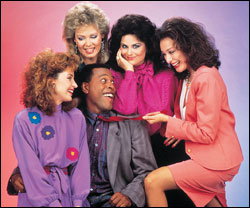
Women soon started to come back in full force behind the scenes in the mid to late eighties, through three television series Designing Women (1986-1993), Roseanne (1988-1997), and Murphy Brown (1988-1998).
Designing Women was created by Linda Bloodworth-Thomason. Thomason was the main writer for the series, and most of the other credited writers were also female. While the show has some slap stick comedy, and often loses out credibility to the superior Golden Girls this show was at the forefront of creating a show about women by women. Thomason added the personal touches to this show making it richer and deeper, talking about gaining weight, spousal abuse, AIDS, divorce, being a single parent, but at the end of the day female friendship.
Roseanne broke new grounds as well it was a show created by her, which she and another female Marcy Carsey, and Tom Werner produced. Roseanne was the first mainstream sitcom about blue collar families. Roseanne ruled the house, and pushed the boundaries of the the traditional mother from the 50s and 60s. Roseanne based this show on her own experiences, wanting to be more realistic. This series also tackled obesity, teen pregnancy, gay issues, divorce, abuse, and much more. At the core Roseanne broke ground because she was herself, and people had never seen anyone like her on television.

At the same time as the other two shows Diane English brought Murphy Brown to life with actress Candice Bergen. English wrote Murphy to be a somewhat flawed (coming out of rehab) smart journalist. Bergen brought Murphy to life with so much much flare; she was truly a force to reckoned with, she was Lou Grant, not Mary. English also broke ground with Murphy, making her a single mother, one of the first, which even got Vice President Dan Quayle is a tizzy.
These women broke barriers, they were loud, stated their opinions, and were not the typical wives and mothers of television. Together these three shows (brought to life by women) represented something which pushed the envelope, and allowed audiences to not feel betrayed by the legacy of Donna Reed et., al. Then there was a shift, as these shows hit their peak Seinfeld and Saturday Night Live, and the numerous cop dramas brought back the boys club. Fewer women were writing, and creating television series. While television quality was advancing the amount of women behind the scenes had plateaued, and even dropped.
Enter Tina Fey the first head writer of Saturday Night Live in 1999. I have written numerous times about the talent of Ms. Fey, but I can't convey more just how important this women has not only been to comedy, but to the face of television. Fey got the ball rolling; she was given the reigns to the "boys club" of Saturday Night Live, while sitting in the Weekend Update desk, and proving how funny, and talented women are. Fey's reign as head writer at Saturday Night Live lasted until 2006. 2006 was also the birth of a show entitled 30 Rock, which Fey, created, produced, wrote for, and starred. Fey's 30 Rock is seen as one of the funniest comedy series of the modern era, and all time.
I have spoken mostly about comedies, because female produced/created/written dramas centered on women from women still have a way to go. The person who changing the face of this female driven drama is Shonda Rhimes (Grey's Anatomy, 2005-Present, Private Practice, 2007-2013, and Scandal 2012-Present). While many will write of Shonda's shows as soapy (which they are) and melodramatic (which they are) there is something about the way she writes people, which gets at the human element so well. Rhimes herself has stated Grey's is a love story for Meredith and Derek, but in reality it's a love story between Meredith and Christina, two women who value their careers more than anything. Shonda has created complex women like Addison Montgomery in the spin-off of Grey's entitled Private Practice. This show like Grey's deals with the eternal working women who walks that tight rope. Scandal is Shonda's passion project, and a show she has always wanted to tell, the show also has the first African American female lead of a drama series since Julia starring Diahanne Carroll. Shonda is the example of the women changing the dramatic television world one step at a time, and her influence will reverberate to shake things up even further.
Fey and Rhimes are just two of the powerful women behind the scenes within the last decade or so Amy Sherman-Palladino, Gilmore Girls (2000-2007), Bunheads (2012-Present) Jenji Kohan,Weeds (2005-2012) Diablo Cody, United States of Tara (2009-2011), Liz Brixius and Linda Wallem, Nurse Jackie (2009-Present, Michelle King, The Good Wife (2009-Present), Elizabeth Meriweather, New Girl (2011-Present), Lena Dunham, Girls (2012-Present), Mindy Kailing, The Mindy Project (2012-Present). This is just the women behind the scenes, many star in their own shows, but the key factor is the growing influence of women behind the scenes, which is creating greater roles for women in television. If only this were the case for film.
From Lucille Ball to Tina Fey to Lena Dunham, these women have impacted the way female characters have been seen on television. Each of these ladies had a voice, and changed the face of a generation. While there could be more diversity (more lesbians, or women of color) that area of diversity has grown slightly as well. There is still a long way to go if you look at the statistics below:
from (http://www.thegrindstone.com/2012/09/18/office-politics/women-creating-more-tv-shows-157/#ixzz2VHRSwNlr)
If you look at late night television as an example most all late television is fronted by male hosts, with mostly male writing staffs, except for Chelsea Lately who is another television pioneer. Women are gaining ground, but she is a prime example of the male dominated world of late night television. Not only are men still the dominate forces in late night, but they are still (percentage wise) most of the actors, producers, writers, directors, and editors. Women have come a long way, but there is still a lot of ground to gain.