Monday, November 21, 2011

Melancholia has some moments of beauty but is weighed down by Lars Von Trier's self-indulgent direction and screenplay

Melancholia (2 out of  5 stars)
Directed and Written by: Lars von Trier (Breaking the Waves, Dancer in the Dark, Dogville)
Starring: Kirsten Dunst, Charlotte Gainsbourg, and Kieffer Southerland


I promised myself I would avoid writing about his comments about Hitler at Cannes, but I guess I lied to myself.  Von Trier stated "What can I say? I understand Hitler, but I think he did some wrong things, yes, absolutely. He's not what you would call a good guy, but I understand much about him, and I sympathize with him a little bit."  This helps pose the question who is Lars von Trier, and is this statement veiled in his work.  My guess (and I am not defending him) is that von Trier was trying to be edgy/ironic in his comments.  Not the smartest choice of words.  

This situation provides insight into the mind behind this film.  Melancholia starts with the wedding of Justin (Dunst) to Michael (Aleksander Skarsgard).  One of the post awkward weddings is held at Justine's sister Claire (Gainsborough) and her brother in laws mansion.  Dunst appears in love and happy throughout the first five minutes of the film, but this quickly disappears while she goes through the motions of the wedding reception.  Dunst slowly walks away from everything, her job her husband, its almost as if when she sees the planet in the sky that she knows things may come to an end.

In true von Trier style he has two parts to the film, the first is entitled Justine, the second Claire.  This can work in films, but in this film it did not work.  I know I am watching a movie, as a viewer I am attempting to suspend disbelief and become part of the world.  This separation makes things feel more like a play, and stylistically I did not see the purpose. The first part focuses on the wedding while the second part focuses on the title Melancholia the planet that was hidden behind the sun that is on a collision course with earth.

What works well in this film are two things the use of Vagner's Tristen and Isolde as the score to the film.  It's masterful, and fits the film beautifully.  I like that von Trier only showed us one aspect on the end of the world.  Dunst's Justine and Claire do have different perspectives on life, and their viewpoints were interesting to watch through.  I do not understand how Dunst's performance is the performance that is singled out; she plays every character she has played before with a bad and snotty attitude.  Gainsborough is much stronger as Claire.  I believe in the Claire character.  Unlike Justin I understood Claire.  Justine's aloofness never resonates with me.  Kieffer Southerland Jon was also great with his wit wonderful sarcasm.

Films do not need to always explain things, but this movie just lets things happen.  I never felt as though von Trier wanted me to care about the end of the world, and its probably something I should care about.  Sitting through this film felt like sitting through one of those pointless class in college where the teacher attempted to sound smart, but the lecture went know where. When I go to the movies I want to enjoy films, I do not want to have to put up with them or endure.

Academy Awards Best Picture Revisited: Juno (2007)

Well this was a fun weekend, my friend Keith came to visit from New York City.  We had a good time, and I thought after he left I would let my liver rest, but I went to Tremont 647, a Boston bar/restaurant and drank.  When I got back I past out and woke so I did not get to watch Juno until  late at night, but I was able to watch it.  Unlike typical Academy Award films, Juno is quick watch, and much more entertaining.   Juno was one of the first films I saw three times in the movie theatre, I have never seen a movie more than three times.

Juno is the product of team of two minds, director Jason Reitman and writer Diablo Cody.  Jason Reitman is the son of director Ivan Reitman.  Ivan Reitman was the mind behind Ghostbusters, and several other films.  Jason Reitman  has done  more than inherit his father' talent he has done something better he has created some of the best films within the last ten years.  Jason Reitman's directorial feature film debut was the 2005 film Thank You for Smoking. Smoking was a brilliant debut, and one two of his films that he wrote.  Reitman's second film was Juno.  Juno launched him into the spotlight.  Reitman then made Up in the Air (which he co-wrote), and this year has a another film with writer Diablo Cody. This was Diablo Cody's first film; she was a former stripper, turned screenwriter.  Cody was the film's lone Oscar winner, and has gone on to write for television; she wrote and created the the show United States of Tara which lasted three seasons.  Cody wrote the terrible film Jennifer's body, and now Young Adult with Reitman, which looks hilarious.  The pairing of Reitman and cody seems to work so well their dark wit combines so well!

2007 was one of the darker years in the history of Academy Awards.  The two films main films competing for this award were No Country for Old Men and There Will be Blood.  Both of these films masterpieces, and two of the best films of the decade.  No Country for Old Men was the winner, and it deserved this award.  I would have awarded Paul Thomas Anderson Best Director for Blood, but the Coen Brothers won for No Country for Old Men.  Where does Juno fit into all of this?  Juno had four nominations: Best Picture, Best Director, Best Actress-Ellen Page, and Best Original Screenplay (which it won).

The five Best Picture nominees were Atonement, Juno,  Michael Clayton, No Country for Old Men, and There will be Blood. Three of the five deserved to be there!  Atonement was not as good as the book, it was a solid effort, but not one of the five best.  Michael Clayton while a solid film was not deserving of this honor.  I actually forgot it was a nominee in this category until I started writing this again.  When a film is forgettable I think that ruins its lasting impact.  Looking back at this year, this was a weaker year.  I would replaced these two nominees with Zodiac (David Fincher) and Into the Wild (Sean Penn).  The other two solid films that could have been contenders were the French film The Diving Bell and the Butterfly (Julian Schnabel) and Eastern Promises (David Cronenberg).

Juno deserved the recognition it received!  I am not sure I would have nominated Reitman for directing, and I would have nominated Jennifer Garner for her supporting role; she was just great. Every time I watch this film I am moved with both laughter and love watching the character grow as she gives up her child.  This is an incredibly heartfelt film that resonates still, and is a classic in my book.  Ellen Page gives a wonderful performance; her humor and naivete mix well.  I like her performance because you actually see her grow throughout the film.  Garner's performance is incredibly real, and raw; she wants a baby so bad.

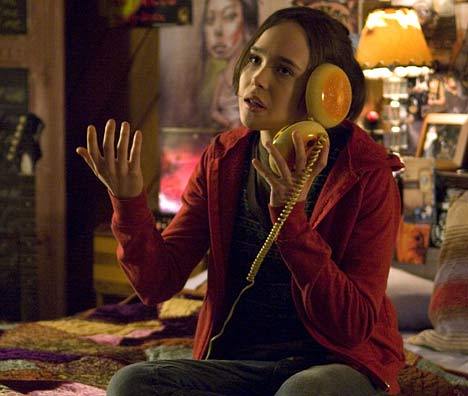
I realize my own personal bias is that I love sarcastic films.  Throw in a hamburger phone, and I am sold home skillet.     I am glad films like this are honored.  The Academy Awards is always heavy on the drama, especially this year.  This film was a much needed breath of fresh air!

Friday, November 18, 2011

Margin Call is a Smart, Thrilling Ride, about the Financial World

Margin Call (3 1/2 out 5 Stars)
Directed and Written by: J. C. Chandor
Starring: Zachary Quinto, Kevin Spacey, Paul Bettany, Penn Badgley, Simon Baker, Demi Moore, and Jeremy Irons

In our current economy the DOW is up and down, there are numerous people losing their jobs, and there is fear that things will not getter better.  This film is about a nameless company prior to the financial crisis in 2008.  At the beginning a group of people come in to tap workers on the shoulder to ask them to come to a room and get fired.  Eric Dale (Stanley Tucci) is tapped on the shoulder.  Dale explains to the women who are firing him that he is working on something he would like to finish, but they tell him that is not an option.  Dale leaves the files with one of his subordinates, Peter Sullivan (Zachary Quinto and says "Be careful."

I would love to explain what caused the crisis, but I do not understand the mathematical logic behind what was discovered.  Luckily rocket scientist (literally a rock scientist in the financial world) Peter Sullivan is able to piece together the different things as he stays late at work and puts together the puzzle pieces.  Sullivan calls his co-worker in risk management Seth (Penn Badgley) and one of his superiors Will Emerson (Paul Bettany) to come back to the office as soon as possible.  Soon after all of the players at the company are called in to work on the problem.  Sam Rogers (Kevin Spacey) is the first to come to the scene.  Sam is the motivational leader on the floor. 

When Sam steps on the scene he asks Peter and Will to explain the situation to him.  When they begin talking financial jargon, Sam says "Speak to me in English."  The ironic aspect of many of the leaders of within the firm or workers is that they do not have a better understanding of numbers or financial terms.  As John Tuld (Jeremy Irons), the CEO becomes involved he commands his team to take the company on a course of action that could change the face of the economy.  Tuld is a man who like Sam has made his way to the top by just being cutthroat and smart.

J.C. Chandor has done a good job with his first major film; he constructed an interesting thriller that is both gripping and intellectual.  The problem with this film is within his screenplay which has a strong, but as the film draws to its close does have as much energy.  Kevin Spacey and Jeremy Irons gave stellar performances, and were the best part of this film.  Their performances gave this films its strength in the last half of the film.

This tale of business and morality is a solid, and provides a strong start from this new film maker.   Chandor uses the economic struggles as a way to describe not only a historical event in our history, but to display what people will do when they are put to the screws and forced to make difficult decisions.  This was a strong first effort and I was entertained by this film.


Tuesday, November 15, 2011

Stylistically J. Edgar is a Clint Eastwood film, but this is one of his weakest films

J. Edgar (2 out of 5 Stars)
Directed by Clint Eastwood (Million Dollar Baby, Mystic River, Unforgiven, Gran Torino)
Written by Dustin Lance Black (Milk)
Starring: Leonardo DiCaprio, Armie Hammer, Naomi Watts and Judi Dench

J. Edgar

Who was J. Edgar Hoover?  The answer to that question is not in this film, but like with most biopics they are only meant to provide a story or version of actual events.  The film starts with J. Edgar dictating his own story to different agents of the FBI.  The film jumps back and forth between Hoover as a young man climbing through the justice department under the Attorney General to founding the FBI, and then working under President Kennedy.  

Hoover served under 8 different Presidents as head of head of the Bureau of Investigations which was later  renamed the Federal Bureau of Investigation (FBI); he was appointed by Calvin Coolidge and died during the Nixon administration.  The beginning of the film shows Hoover's ambition within the Bureau and how believed that systems could be created to track different people, like using their fingerprints.  As Hoover dictated his story throughout the film, he kept changing the agent who was typing his story, because they either did not answer a questions correctly, or he did not like the way they spoke or dressed.   

The direction of this book Hoover was dictating pointed to him as a brilliant man who fought the Bolshevik Revolution along with Communists in general, brought down gangsters like John Dillinger, had power and control over Presidents, and who helped solve the mystery of the Lindburgh baby.  In reality Hoover was a paranoid man who rarely arrested anyone, made himself look like more of a hero than he actually was and took credit for the work other people did.  

Hoover's second in command throughout his entire time within the agency was Clyde Tolson.  Within the the film there is an insinuation that Hoover was a closeted gay man who had a "relationship" with Tolson.  There is limited proof on anything specific, but what this film does highlight is that Hoover was a complicated man with many demons which he tried to keep hidden.  DiCaprio plays the titular character and does a good job capturing every element of Hoover's character; he is great in the role and is the highlight of this film.  DiCaprio played another troubled historical figure, Howard Hughes in The Aviator, and it is apparent that this man take on incredibly complex roles and rise to the occasion. 

The rest of the cast did an alright job.  Armie Hammer's Clyde Tolson did a solid job playing the second in command, but his makeup while older was terrible.  Judie Dench who played Hoover's mother and Naomi Watts who played Hoover's secretary were just there, there was nothing spectacular about either of their performances, mainly because the script never created a moment for them to shine.

The team of Eastwood and Black tried to take on a complex man in a simple way, but the direction and script had numerous flaws.  While I was never bored this film began to fade towards the ending.  Every time I heard DiCaprio do a voice over I assumed the film was coming to an end, but this happened about four or five times before the film actually ended.  Eastwood's films have this grey look to them, and as a period biopic this worked, but unlike other films I never cared about the plot.  Answering who this man was, was never going to happen, but they made his story less interesting.  The inclusion of the different historical context was poorly woven into the fabric of the film.  

All of Hoover's accomplishments which built his road to "success" were not handled well.  Hoover had a complicated life, but it feels as though this film attempted to take on too many aspects and there was no true focus.  Eastwood is a taut director and usually has such wonderful focus, but this film does not, and Black's script is sometime awkward and clumsy.  I wanted this film to be good, and I glad it focused the rumored homosexuality, but even that was handled awkwardly.  The film does not have a center of gravity and often never finds its central theme.  Eastwood should be kissing the ground DiCaprio saved this film, now go back to Scorsese!


Sunday, November 13, 2011

Academy Awards Best Picture Revisited: The Curious Case of Benjamin Button (2008)

I had planned on watching the Best Picture winner, Slumdog Millionaire, but I must have let someone borrow my copy, because I could not find it.  So I went with one of the other four nominees that I had not seen in a while, The Curious Case of Benjamin Button.  The other nominees this year Milk, Frost/Nixon, and The Reader.

Button was directed by the talented director David Fincher, who directed great films like Alien 3Se7en,
next Fight Club, Zodiac, and in 2010 The Social Network.  Fincher like Tarantino is known for quirkier/darker films.  Along with feature films, Fincher has worked with musicians to help direct  documentaries of their work, and work with music videos.  His first major foray into the feature film was in 1992's Alien 3.  While Alien 3 is not the strongest in the series it was a solid endeavor, and if they had kept it at three films this franchise would have been impeccable. 1995's Se7en has not ounce of light, there is always this bleak rainy feeling. Fight Club (1999) is his darkest and most obscure piece of work as a director; he handles the adapted material well, and this one of my favorite films.  In the the midst of these two works of greatness Fincher had two let downs, The Game (1997) and Panic Room (2002).  Both films had solid casts and premises but there was just not much there.  Fincher came back to his true stylistic form in 2007 with Zodiac.  Zodiac is a dark ominous thriller that details the story of the hunt for the Zodiac killer.  Then in 2008 Fincher was honored with his first Academy Award nomination for directing The Curious Case of Benjamin Button.


I have to be honest, Fincher is not my favorite director, but he holds high rank in my opinion with current film making.  Button should not have been his first nomination in the directing category, and I am kind of appalled that it took the Academy 17 years to honor this man.  Fincher's directorial work should have garnered him numerous accolades, but this picture is about more than David Fincher!

In 2008 the five films nominated for Best Picture were: The Curious Case of Benjamin Button, Frost/Nixon, Milk, The Reader, and Slumdog Millionaire.  This was the year The Dark Knight, the film with the second highest rated film with critics, and a popcorn flick to boot was left off the list.  The same can be said with Wall-E.  Wall-E was the first animated film that deserved to be nominated and win in a long time!  This was also the year of The Wrestler an amazing film about a man struggling to make it into the world of professional wrestling.  Those three previously mentioned films were some of the best film making and the Academy ignored them.  With only five nominees they picked the wrong five.  I would have nominated The Dark Knight, Milk, Slumdog Millionaire, Wall-E, and The Wrestler.

In reality the 2008 Best Picture race winner was locked up early on.  Slumdog Millionaire steam rolled the competition.  Millionaire had taken a classic story of the under dog an put a Bollywood spin on the subject matter.  The Academy felt as though they were being hip and edgy by rewarding a cross cultural film that could transcend to America.  Benjamin Button had no chance but it was most likely in second because of the the big important production value, and the gravity of the story that spanned decades.

In reality if there had been ten nominees Benjamin Button would have probably made my list, but with five it did not have a chance for me.  Benjamin Button feels like Forrest Gump, and there are numerous transferable qualities of both stories. namely because both films were written by the same person Eric Roth.  Button feels self important like Gump does from a critics stand point.  Button like Gump is about a boy who is different from birth, who has a hard time walking, meets a girl who treats him different from those around him and they fall in love and are defined as soul mates (like Forrest and Jenny), benjamin works on a boat, and the film uses historical context to help tell the story.  Roth's screenplay is entirely different from F. Scott Fitzgerald's short story, and the only real similarity is that the central characters name is Benjamin Button.  Roth seems to use gimmicks from other screenplays to force charm in this film.  I still cry at the end, not to seem heartless.
Brad Pitt


The film had 13 nominations, more than any film that year, including Best Picture, Best Director-David Fincher, Best Actor-Brad Pitt, Best Supporting Actress-Taraji P. Henson and Best Adapted Screenplay.  Statistically speaking, the film with the most nominations going into the night typically wins the Best Picture Award, but this film did not do so.  I would have only nominated this film for the Best Director honor.  Fincher's direction is the star of this show, and everyone else is along for the ride.  Pitt received his second nomination for this film, but should have received a nomination in the Supporting Actor category this same year for Burn After Reading.  2008 had people who had won previously talk about the different actors.  When Goldie Hawn talked about Taraji P. Henson, I did not get the praise for her performance, or what Hawn had said, and I still do not.  The screenplay has glimpses of greatness, but also major story flaws that could have been cut out.  I will finally admit that my fried Mike was right about the scene with the clock at the beginning.  The scenes symbolism was forced and heavy handed.

I sound like a grump, I know, and the thing is, I do not hate this film, but I do not think it's special or worthy of taking away the spot films that were better.  This category has two films that were much worse The Reader and Frost/Nixon.  Both of those films had strong leading performances, but were otherwise boring.  In a year with much more exciting films I am saddened to look back and see the Academy played it safe once again.  They honored another Holocaust film because it seemed important, and honored another film about Nixon because because of its subject matter.

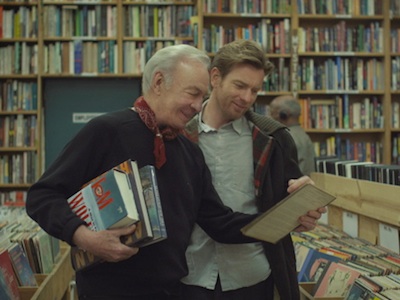
Beginners, Adeptly tells the Story of two men Starting to Find Love Late in Life

Beginners (3 1/2 stars out of 5)
Directed and Written by: Mike Mills (Thumbsucker)
Starring: Ewan McGregor, Melanie Laurent, Goran Visnjic, and and Christopher Plummer


Love is seen as an important to emotional stability. The definition of of love is so broad.  Love can mean love of family, friends, God, or that eternal love of another human which people marry or form a longer lasting relationship. Beginners is the story about a father and son Oliver (McGregor) and Hal (Plummer) starting their journey finding that last kind of love.

The film starts with Oliver rifling through his father's belongings, finding and finding things in his father's place like his first personal ad in the gay world.  At the beginning of the film the director establishes one timeline where Hal has already passed away.  Oliver then takes Hal's dog to his home, a dog which speaks in subtitles to Oliver (but he only knows 150 words).  

The film jumps to the next timeline where Oliver's mother has passed away.  Oliver uses photos of the past to describe the way things looked explaining what his parents marriage looked like, the president, pets, happy people.  He uses happy families to compare to his own because he always assumed they were not happy. Hal comes out to Oliver after this sequence.  Oliver imagines that he told him in a purple sweater, but Hal actually told him in his bathrobe.  The director/writer uses these quirks while editing together different images of Hal in a purple sweater and bathrobe.

Soon after his father's death Oliver is taken to a party where he dresses like Freud.  At the party he meets a beautiful young woman, dressed in a male costume (I don't know who she was supposed to be), and her name is Anna (Laurent).  Anna talks to Oliver with a notepad because she has laryngitis.  Anna asks on her notepad, why are you a party if you are sad.  Oliver is amazed she can tell.  Anna draws eyes on the notepad and tells him that is how she figured out his secret.  McGregor and Laurent have amazing chemistry, and they provide solid performances in this film

In Hal's story we get to experience this older man working to be something in the gay community; he meets friends, join activist groups, has movie and book nights, and takes a lover in Andy (Visnjic).  Hal has started his journey at the end of his life; he has found happiness in moving forward and finally being himself.  Hal is living his life and exploring for a the first time, a life where he is free to love whomever he wants.  Hal wants his son to be able to do the same.  Plummer is the standout in this film; he plays Hal  with such charisma and heart.  I loved watching him call and wake up Oliver as he came home from the club asking about House music.  Plummer plays this role with sincerity.

In a third timeline Oliver is younger (about 10) and we see him only with his mother, and even while at his own father's gallery opening we never see Hal.  Oliver did not understand his parents relationship, and viewed as a loveless couple.  Oliver promised he would never become them, and has prevented himself from that until watching his father explore his own love life, and meeting Anna.

Director/Writer Mike Mills uses his semi autobiographical experience to tell this story.  Mike Mills experienced this exact story; his mother died from cancer then his father came out, and died fours years later.  Mills has done a good job exploring the world of coming out for love with both stories.  Both Hal and Oliver are facing their past and moving forward to begin their journey.  Mills script is a bit too quirky at times, but it's also incredibly emotional and heartfelt giving it enough to surpass that quirkiness.  The message is love, and working towards finding a love that makes you genuinely happy.


Saturday, November 12, 2011

Take Shelter Brings Fear to a Whole new Level

Take Shelter (4 1/2 out of 5 Stars)
Directed and Written by: Jeff Nichols
Starring: Michael Shannon and Jessica Chastain

Take Shelter


In today's era people fear almost everything.  With the economy tanking people have a fear of losing, well everything.   Take Shelter starts with Curtis LaForche standing outside of his home while his wife cooks and his daughter is playing.  In the distance Curtis sees storm clouds, and its start to rain a yellowish color, a signal of the end of days.  This starts a cycle of paranoid acts, and dreams as Curtis struggles to keep his family afloat.

After a long day of work Curtis spends a night out at the bar with his co-worker and best friend Dewart.  Dewart (Shea Whigham) starts talking about his own problems while the two drink and ends up saying "You got it good."  The problem is Curtis has real issues like everyone else.  Curtis supports his family while his wife Samantha (Jessica Chastain) stays at home to take care of Hannah (Tova Stewart) their six year old deaf daughter.  Curtis's income and benefits are essential in helping his daughter get surgery for a cochlear implant.

Curtis's first dark dream involves his dog biting him, and after the dream he feels the pain of the bite as though dream were reality. Curtis starts to come undone as his dreams about having his family taken away from him, and as he continues to see a storm on the horizon. Curtis takes action in order to protect himself and his family from the darkness of his dreams and visions. Curtis starts building more to his bomb shelter using equipment from work.  Curtis soon starts to alienate people through his actions and his world unravels as he tries to prevent it from doing such.

Writer/Director Jeff Nichols does an amazing job creating a world where reality and paranoia blend.  Nichols shows two worlds, but the worlds start to blend together and Curtis appears to have a hard time distinguishing between what is real and what is not. The use of limited visual effects helps to keep the movie on a different level from most other films.  While Nichols uses the elements of the storm and a flock of bird to symbolize a darker future.

Michael Shannon is brilliant in this film!  Shannon's Curtis is a stand up guy, a family man, a friend, who starts to see things fall a part.  Shannon slowly unhinges; he fears he is turning into his mother (Kathy Baker) who was diagnosed with paranoid schizophrenia when he was 10.  Curtis visits her on his quest to determine whether he is actually crazy or the end of days is coming.  Shannon is one talented actor, and so far has given one of the best performances i have seen throughout this entire year. 

 Jessica Chastain also gives a great understated performance as wife.  Chastain has starred in two other movies I have seen this year, The Help and The Tree of Life.  This woman has proved in a short time that she has the acting chops to go toe to toe with some heavy hitters, and in this film she gives her best performance of the year.  Chastain's Samantha goes from happy homemaker to wrought wife desperately trying to help her husband and her family survive.

There is something spiritual and potentially biblical about this film.  In a scene with Samantha's family, her father asks Curtis about his not attending Church.  Curtis responds with a question "How was the service?"  While I do not think the film was intentionally religious I do think the film mirrors a quest to feel at peace.  Curtis paranoid state about his economic woes cause mental anguish.  Together these elements create one stellar film.